
Building a website is like opening a high-end boutique in the middle of a vast, silent desert. You can have the most beautiful layout, the most revolutionary products, and the fastest checkout process in the world-but if you don’t build a road to your front door, nobody is coming.

In the early days of the internet, “building the road” was simple: you stuffed some keywords into a page, and Google did the rest. But it’s 2026. Search engines are now AI-driven “Answer Engines,” social media platforms are walled gardens that hate external links, and users have shorter attention spans than ever.
The good news? You don’t need a $5,000 monthly ad budget to get your first 1,000 visitors. You just need a smarter map. Here are five free, high-impact strategies to drive traffic to your brand-new website.
1. Master “Answer Engine Optimization” (AEO)
Traditional SEO isn’t dead, but it has evolved. With the rise of AI-generated overviews, users often get their answers directly on the search results page. To get traffic today, you must optimize for Answer Engine Optimization (AEO).
Why it works
Instead of trying to rank for “Coffee Beans” (where you’ll be crushed by Amazon and Starbucks), AEO focuses on solving specific, complex problems. When you provide the clearest, most structured answer to a question, AI models and search engines cite you as the primary source.
How to implement it:
- The “Inverted Pyramid” Writing Style: Start your articles with the most important information. If your post is about “The best time to plant tomatoes,” the very first sentence should be: “The best time to plant tomatoes is usually late spring, specifically when nighttime temperatures consistently stay above 50°F (10°C).”
- Use Definition Boxes: Create a physical box or a distinct paragraph that defines a key term in your niche. Search engines love to pull these into “Featured Snippets.”
- The Power of $H2$ and $H3$ Tags: Use your subheadings to ask the questions your audience is typing into Google. Don’t just write “Materials”; write “What materials do I need for DIY pottery?”
2. The “Trojan Horse” Strategy: Leveraging Feeder Platforms
When your website is 30 days old, it has no “Domain Authority.” Google doesn’t know if you’re a world-class expert or a bot. However, Google does trust platforms like Medium, LinkedIn Articles, and Substack.
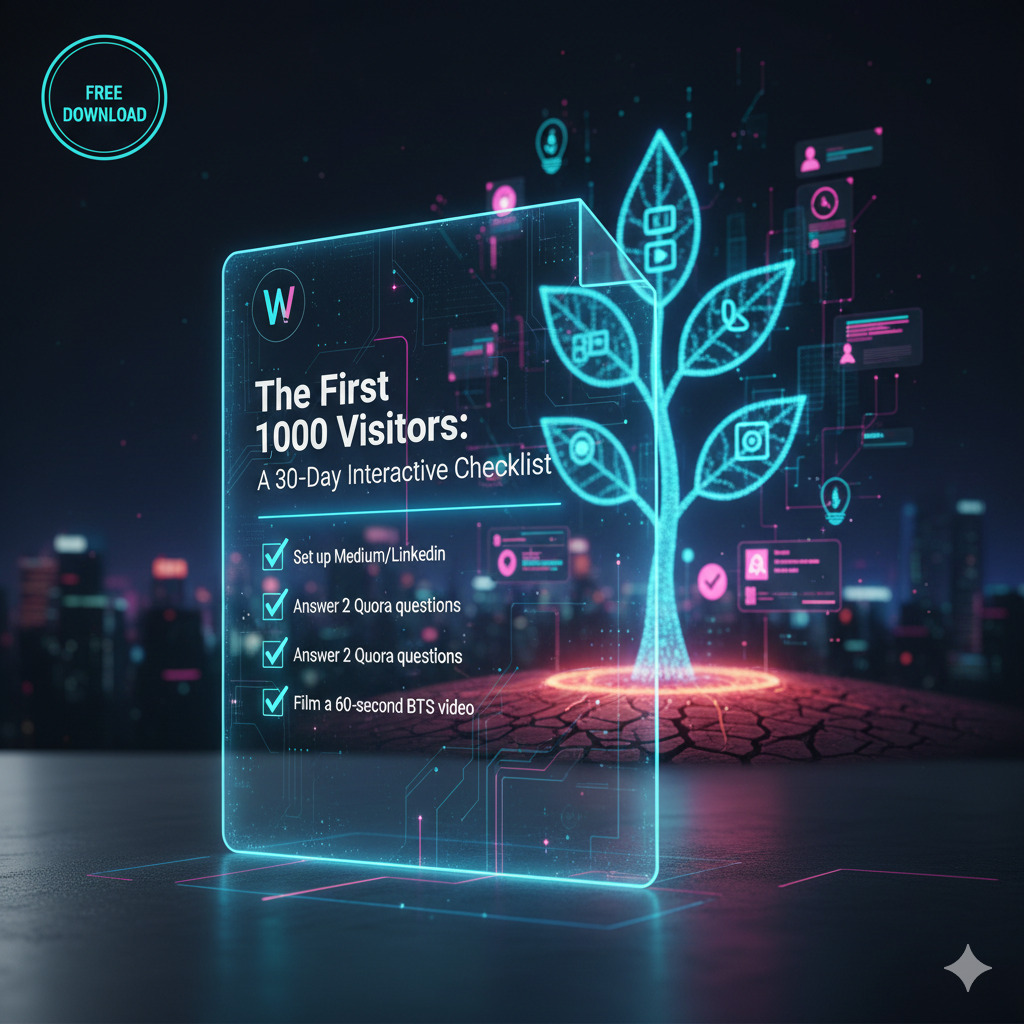
From 0 to 1,000 Visitors—Free!
Stop guessing and start growing. Get the exact 30-day checklist I use to drive high-quality traffic without spending a cent on ads.
🔒 100% Free. No spam, ever.
Borrowing Authority
The “Trojan Horse” strategy involves publishing your best content on these high-authority platforms and “feeding” that audience back to your main site.
The Step-by-Step Process:
- Publish on your site first: Always host the original version on your own domain to establish ownership.
- Syndicate 48 hours later: Copy a condensed version of the post to Medium or LinkedIn.
- The “Cliffhanger” Method: Give away the “What” and the “Why” on the feeder platform, but keep the “How” (the templates, the checklists, or the deep data) on your website.
- The CTA: End with: “I’ve built a free calculator/template to help you do this faster. You can download it here [Link to your site].”
3. Community-First Growth (Reddit & Discord)
In an era of AI-generated content, humans are craving human connection. People no longer trust “Best 10 Vacuum Cleaners” articles written by anonymous bloggers; they trust “u/VacuumGuy99” on Reddit who has repaired machines for 20 years.

Finding Your Tribe
Communities on Reddit, Discord, and niche forums are “High Intent” environments. If someone is in a “Home Office Setup” Discord, they are actively looking to spend money or solve a problem.
The “Help, Don’t Sell” Rule:
- The 90/10 Rule: 90% of your activity should be helping people without mentioning your website. Answer questions, provide encouragement, and share your failures.
- The “Resource” Drop: When you do share a link, don’t frame it as an ad. Frame it as a resource.
- Bad: “Check out my new blog post on desk chairs!”
- Good: “I struggled with lower back pain for years. I actually tracked 15 different chairs and their lumbar support specs in a spreadsheet for my site-happy to share the link if it helps anyone else.”
4. Short-Form Video as a Discovery Engine
In 2026, TikTok, Instagram Reels, and YouTube Shorts are the most powerful discovery engines on the planet. Their algorithms are designed to show content to people who don’t follow you yet.
Turning Views into Visitors
The challenge with short-form video is that it’s hard to get people to leave the app. You have to make the “Click” feel like the natural next step of the story.
Content Ideas for New Websites:
- The “Behind the Scenes”: Show the process of building your site or product. People love an underdog story.
- The “Common Myth” Debunk: Take a popular piece of advice in your niche and explain why it’s wrong in 60 seconds. At the end, say: “I broke down the actual data on my site—link in bio.”
- The “Visual Tease”: If you wrote a 3,000-word guide, record a video of you scrolling through it, highlighting one specific “golden nugget” of info, and telling them where to find the rest.
5. Digital PR and the “Power of Others”
You don’t have to build an audience from scratch if you can get in front of someone else’s. Digital PR is the art of getting mentioned by established voices in your industry.
The Guest Post 2.0
Forget low-quality guest posting for “backlinks.” Focus on Value-Add Guesting. Find a newsletter or a blog that is slightly larger than yours and offer them a piece of content that would take them hours to research, but you’ve already done.
The “Expert Roundup” Flip
Instead of waiting to be invited to a roundup, host one yourself. Reach out to 5-10 micro-influencers in your niche and ask them one specific question (e.g., “What’s the one tool you can’t live without?”).
Once you publish the post on your site:
- Email the influencers to let them know it’s live.
- Provide them with ready-made social media graphics.
- They will likely share it with their followers, sending a flood of high-quality traffic back to your site.
Maximizing Your Traffic: The “Leaky Bucket” Check
Before you drive these visitors, you must ensure your website isn’t a “leaky bucket.” If 1,000 people visit and 1,000 people leave without taking action, you’ve wasted your time.
The Conversion Checklist:
- Page Speed: If your site takes more than 3 seconds to load, 50% of your “free” traffic will bounce before they even see your logo.
- Mobile Optimization: 70% of your first visitors will likely come from a smartphone. Ensure your buttons are clickable and text is readable.
- The Lead Magnet: Give them a reason to stay connected. Offer a free PDF, a discount code, or a “Coming Soon” newsletter signup in exchange for their email.
Comparison of Methods
| Method | Time Investment | Speed of Traffic | Long-term Value |
| AEO (Search) | High | Slow | Permanent & Passive |
| Feeder Platforms | Medium | Medium | Brand Authority |
| Communities | Medium | Instant | High Trust/Loyalty |
| Short-Form Video | High | Instant | Viral Potential |
| Digital PR | High | Slow | SEO & Networking |
Conclusion
Getting your first website visitors doesn’t require a credit card; it requires generosity. In 2026, the websites that win are the ones that give away the most value for free on the platforms where people already hang out.
Start with one strategy-perhaps Reddit or Short-Form Video-and master it. Once you see those first 10 or 20 daily visitors trickling in, layer on the next strategy. Before you know it, that desert boutique will have a highway leading straight to its door.